Showing posts with label Magazine: Longevity. Show all posts

Mission Possible: Happy Holidays

Surviving the silly season? Our ultimate guide to staying sane, slim and active during the festivities will help you through the rough spots!


STAY SANE


• Focus on the intangibles
Acclaimed author of the book Money Alchemy (www.moneyalchemy.com), Kiki Theo, retired a multi-millionaire at age 39 and is credited by entrepreneurs worldwide as being the catalyst for their ongoing success. “I think we need more focus on the non-tangibles in life; fun, laughter, rest, love, leaping, sunshine, eating and being merry. I think we need to change our focus from shopping, creating debt and fat, to eat, pray, love (sorry Liz!),” says Theo. “We need to create a Christmas which also focuses on the non-tangible for gifts; giving hugs, time, love and attention. For shopping, I recommend shopping for a laugh, a kind word, a sexy glance and a new cause to champion. For fun I say laugh, write some jokes, play a prank and wear a hat! For pastimes, I say walk, run, jump, make love, press flowers and look for fairies, and, for indulgence; run through the forest wearing nothing but chocolate and have a moonlit stroll while you munch on cheese sandwiches. We need to give others kindness and a bit of our heart. The rest will naturally and easily follow if we approach things in this way, realising that everything is connected.” 


• Love yourself
Teaching others about self-esteem and creativity for the last five years, Amy Morgan, is the director of the Institute of Self-Esteem for Africa, www selfesteemfa.co.za. “We place so much pressure on ourselves – especially during the festive season. The discomfort of reaching another year-end with our goals not fully realised can be a painful experience and the temptation to turn to self-medicating with over-indulgence, over-spending and not getting the exercise that we need, can indeed overwhelm us,” says Morgan. “Also, at this time of the year, people compare themselves to one another and get depressed if they do not measure up. Our workshops help to alleviate that, replacing this habit with accurate self-assessment and helping one to realise their true worth. Learning to recognise your personal achievements and know what you want for yourself alleviates feelings of not measuring up. Focus on upping your self-esteem, realising you are enough and you are on your way to surviving the insanity of the season!”


• The law of attraction in action
“The Law of Attraction suggests that we ‘attract’ what we most focus on – in thoughts, words and actions,” says motivational speaker and clinical psychologist, Reinette Steyn, coordinator of Selfgrow Life Skills Development workshops, www.selfgrow.co.za. “With that in mind, remember to smile! The very act releases stress-relieving chemicals, and brings about feelings of joy, competence, confidence and tolerance.  It also decreases stress and reactivity in other people around you, resulting in a more peaceful and enjoyable time for everyone.” Steyn suggests adopting a group mentality when shopping or in crowded spaces over the festivities. “Rather than saying to yourself; ‘I can’t understand why everyone else is doing their shopping so late!’, rather say; ‘We are all so eager to buy gifts for others – how nice that humanity is still so generous!’ This will cause less stress and cholesterol build-up and attract happy experiences to you. Remember: thoughts become things!” 


• A little help from energy medicine
“Crystal Elixirs fall in the category of energy medicine. Like flower essences, it’s mindful-medicine and it's all about taking responsibility for life and for your actions,” says owner of Healthy Choice, Markus van der Westhuizen, a crystal healing practitioner and teacher and Reiki Master practitioner, who has been working with crystals for healing since 1992. “I have created a comprehensive range of crystal elixirs, which include essences for depression, weight issues, immunity, meditation and addictions, among others – all issues which arise over the festive season – and which can be obtained online at www.healthychoice.co.za.” Van der Westhuizen suggests the following stones for staying sane over the holidays; “Amethysts help curb over-indulgence and assist with balancing the body and mind, lepidolite is one of the best stones for frayed nerves, amber stimulates a sluggish digestion, kunzite facilitates stress relief and helenite (aka Gaia Stone) helps to induce compassion, while diffusing anger. Taking a few conscious breaths also helps!” Book an energy healing session this holiday with Healthy Choice and receive a 10% discount on your treatment or your purchase of a crystal elixir. To book, email markus@healthychoice.co.za or call 021-447-7604. 


• Get stuck in the garden
“Gardening is a deeply therapeutic act. Modern life has the effect of scattering people – and they often find it difficult to hold it together, especially over the holidays. Spending time in nature and engaging in gardening brings the body back into alignment – and I like to think of it as ‘land-therapy’” says Sam Huckle, owner of Plantwize, www.plantwize.co.za, the only organic landscaping company in the Western Cape to focus on permaculture and bio-dynamic farming as a priority. Organic gardening is a method that emphasises the use of composting as opposed to using artificial chemicals on soil and plants –and, Biodynamic farming takes organic farming to the next level. It also places importance on the interrelation between the soil, plants and animals and uses the astronomical sowing and planting calendar to develop the land. Huckle offers workshops on growing edible garden spaces.  “Our workshops are about waking people up to real food. They’re about the health factor of growing your own organically and eating it fresh and preferably raw. This is a very calming, slowing, soothing, energising and enjoyable activity and a great help to keeping you sane over the festive season.”


STAY SLIM!


• Plan your meals
“Try your best to plan healthy meals and snacks on those days that you know you will have a festive meal. Don’t starve yourself before the meal, because it will make it more difficult for you to control your eating,” says registered dietician and chairperson of the Gauteng South branch of the Association for Dietetics in South Africa (ADSA), Lila Bruk. “Be flexible in that you allow yourself a little of the foods you really want, but keep the portions small, so that you don’t overdo it. Simply put, don’t overindulge to the point that you feel uncomfortably full, bloated and guilty – rather indulge in moderation.” Bruk explains that the key is not to feel deprived, but to still keep your weight in check. “Don’t be afraid to be original this Christmas lunch and celebrate over a low-fat meal, like a fish-braai, or an elaborate salad bar. Another idea is to have a Christmas brunch and serve fresh fruit, eggs and rye toast,” says Bruk. She also recommends eating low-GI foods to stay fuller for longer, so that you are not ravenous by the time of the festive function. “Finally, take advantage of the warmer weather by eating lighter meals, being more active and enjoying the summer fruits,” she says. “By trying to maintain healthy eating habits over this time you can ensure that you start the New Year feeling slim, healthy and energised!”


• Eating mindfully
“When you are always on a diet to try and control your weight, the holiday season can be an absolute nightmare!  All the ‘nice food’ is fattening, and it is everywhere you go,” says Bronwen de Klerk, owner of Chi-Netix Health Studio, www.chi-netix.co.za, in Cape Town and facilitator of the Middle Weigh Mindful Eating Programme. “The Middle Weigh is not a diet, it is a programme that will help you get in touch with your body, so that you will know the food and its quantities your body requires. The workshops teach you how to recognise your hungry and full signals through fasting, by eating only two meals a day and drinking liquids and eating fruit between if you get too hungry before your second meal.” The four-step programme teaches love for the self, listening to the body, getting in touch with the emotions and strengthening the bond with the body, which translate into making peace with food and eating and living a happier, healthier life.  “It will simply lead you on a journey of self-discovery, so that you can get to the core of your weight and food issues. Since your guidance on eating is coming from within, and not from a diet, you will be able to easily continue with holiday and life events without feeling any restriction,” she says. Chi-Netix Studio is offering readers 10% off the Mindful Eating Programme for the holidays. To book, email bronwen@chi-netix.co.za or call 073-334-7554. 


• Fat-zapping Ozone therapy
“Step into an already cosy, warm ozone cabinet and allow your body to be saturated and surrounded with warm steam to open the pores fully. Ozone or O3 is then introduced into the cabinet via medicinal grade oxygen,” says Kym Eagle. owner of O-Zoned Oxygen for Life at Constantia Wellness Centre in Cape Town.  “Ozone is the most powerful and rapid-acting oxidizer man can produce and is able to oxidize all bacteria, moulds, yeast spores, viruses and pathogens. So, whilst you sit relaxed and soothed by soft music, the O3 is at work, penetrating your skin and body tissues, including your cells, blood, lymph and body fat.” According to Eagle, since a majority of the toxins are held in the lymph and fat in the body, this treatment is especially effective in weighty issues. O3 helps to break down the fat into hydrogen and oxygen molecules and releases them easily via the excretory system, through sweat and urine, sparing your liver and kidneys extra work. “In addition, you burn 300 to 500 calories with each session, so not only do you benefit from detoxing your bodily systems, you also get the added benefit of smooth, tight, cellulite free skin,” she says. 


STAY ACTIVE!


• How not to tip the scales
“On average, I estimate that people eat four times as much during the silly - or should I say sully season, compared to the rest of the year. If you are consuming more calories than you are burning, it makes sense that you will pick up weight. You need to be burning more calories than using your arm to lift a glass of wine, beer or that last piece of Christmas cake,” says Wellness Facilitator, Andrew Wyllie, owner of Phoenix Wellness Studio in Cape Town. “Admittedly it is difficult to get to the gym if you are away for the holidays, so use the time to try something new, like surfing, paddle-boating, hiking up a mountain, or riding a bike. Explore your holiday surroundings by being active.” Wyllie suggests trying your best to not to fall into a trap of over-eating drinking too much and being inactive. “You will be doing yourself an injustice to all the hours you spent trying to get your beach body in the first place!” 


• Nia: joyful, achievable, energising exercise
Brown belt Nia teacher, Simone Bothma, started doing Nia to get back in touch with her body, after working in the field of counselling and psychology. “Nia is a wonderful to stay fit during the holidays because you sweat without effort – and you sweat with joy! For some, it is the first time they have felt happy while exercising because they are guided by their own body’s sensation having fun and being tuned in, so if your knee says ‘no’ – you hear it and you adapt your movement until the knee says – ‘yes, now that I enjoy!’”  Founded by Debbie and Carlos Rosas in the US, the couple wanted to find something better than the aerobics ‘no pain, no gain’ era, so they set about studying many different modalities and thus gave birth to Nia (www.niasouthafrica.co.za). It offers a combination of jazz, modern, tai chi, tae kwan do and Aiikido, as well as incorporating the healing arts of the Alexander technique, Feldenkreis and yoga, each bringing awareness to the muscles and the bones, so that the body is instructed to move in its own way. The aim is to create balance and harmony in the body and the overall feeling is one of pleasure. “Nia appeals to all ages, shapes, sizes and ability – as it is taught on three levels, depending on your energy levels at the time of the class.” 


• Saluting the sun through Yoga
“Yoga helps your body on all levels - body, mind and soul. On a physical level, the poses (asanas) keep you flexible, supple and strong, the breathing helps you to relax the body taking you to the next level of relaxing the mind, helping you to stay calm, centred and present in the moment,” says Deevya Vasson, Hatha yoga instructor at The Centre Yoga Meditation in Cape Town, www.thecentre.co.za. “It's not easy when the festivities and over-indulgence are all around you. It’s best to stay centred, or learn how to practice staying centred, and do whatever works best for you. I prefer to look at my yoga practice as giving back and sending thanks to my body for looking after me so well. This way it is not a torture, but rather, a treat.” Vasson suggests learning the most popular asana sequence in yoga – the sun salutation as a way to kick-start your energy levels everyday of the holidays. “This will keep you toned and fit. Also, keep your yoga mat in a special place where you can see it, so all you have to do is step on it and move!”


• Live simply, embrace martial arts
“Often what happens during the holiday season is an extreme in emotion – either overly excited or overly sad – and in martial arts we encourage withholding a fraction of this emotion, so as to conserve energy and maintain a harmonious balance,” says Dr Jeff Lan, 8th dan Chinese martial arts and Qi Gong coach and head instructor of the International Kim Loong Wushu Centre, www.kimloong.org, in Cape Town. “Remaining calm and focused this season and not getting too caught up in the moment is emphasised – similarly, when physically active, apply the same concept. Too much physical activity can strain the internal organs, which get strained, thus depleting energy.” According to Dr Lan, martial arts training produces a good physique, sharp mind and defined muscle tone.  The body is generally much stronger and youthful and degenerative diseases are less likely to occur as a result. Martial artists become competent, self-assured and confident.” 


Author: Charlene Yared-West, Longevity Magazine, December 2010/January 2011, p15. 

Eat Today, Starve Tomorrow


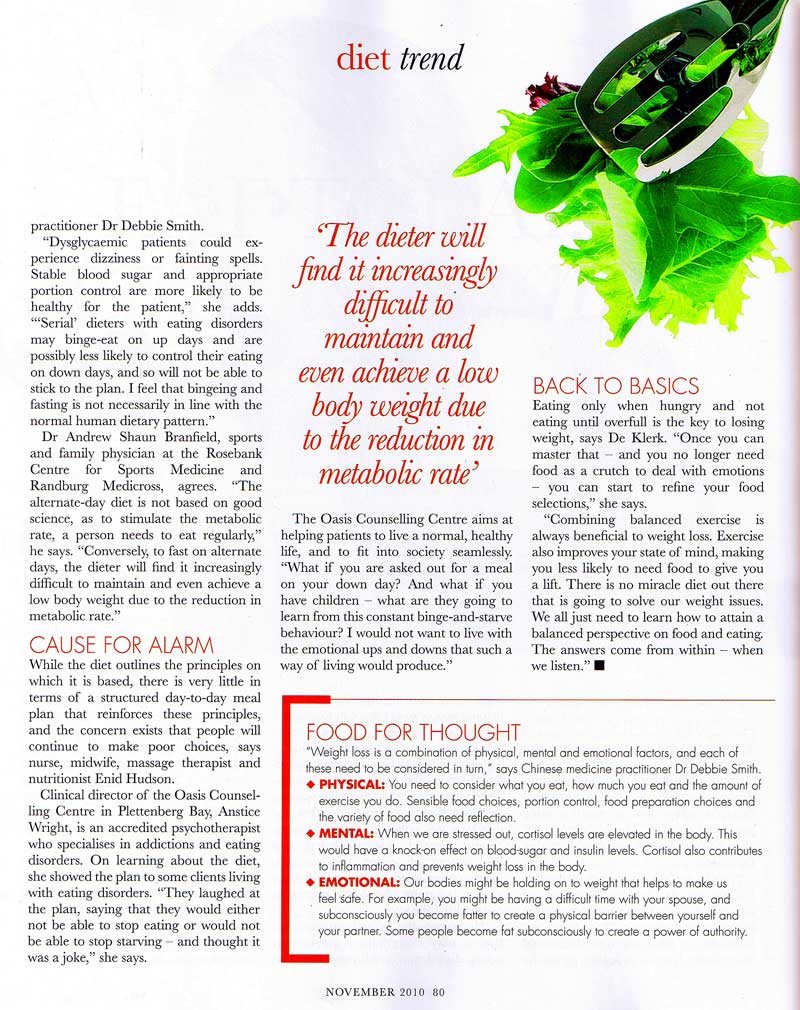
The newest craze to hit the world is the Alternate Day Diet, otherwise known as the Up Day Down Day diet, developed by New Orleans plastic surgeon, Dr James Johnson. Is this just another fad diet, soon to lose its popularity – or is it for real? We talk to the experts to shed some light on the subject. 

Eat what I like on one day, fast the next
After struggling to lose weight – and witnessing his patients’ constant battle with the bulge, Dr James Johnson dedicated his research to finding a way to help himself and others achieve weight loss and overall body health. On up-days you are allowed to eat whatever you like on the diet and the next, you have to limit your intake to 20 percent of what you normally eat, at about 500 calories. Sound easy? According to Dr Johnson it is. By restricting the caloric intake in this way, the body undergoes a mild form of stress and in turn activates a gene called SIRT1, also known as the ‘skinny gene’.  According to his research conducted on mice, this gene helps the body to lose fat by releasing it from around the organs. Dr Johnson explains that the diet plan also decreases the risk of disease, such as heart disease, stroke, Alzheimer’s, Parkinson’s, asthma, allergies, arthritis and diabetes. 

Red, red wine and resveratrol
In conjunction with the alternate day eating plan, Dr Johnson recommends taking his specially formulated supplement, containing Resveratrol, which is a molecule found in red wine, believed to turn on the SIRT1 gene. In 2003, research conducted on the substance showed that resveratrol could boost the lifespan of yeast by 70%, as well as round worms, fruit flies and fish. A later study in 2006 showed that resveratrol could increase the lifespan of mice, reduce their risk of heart disease and other age-related diseases. Presently, Dr Johnson and other scientists are conducting human trials to confirm that resveratrol has the same effects in humans as it does in the other organisms that have been tested. 

Professor Louise Warnich of the Department of Genetics, Stellenbosch University questions Dr Johnson’s rigorous promotion of resveratrol to trigger the SIRT1 gene. “The SIRT1 gene is one of the approximately 20 000 genes present in the nuclei of human cells. Gene activation or gene regulation is a complex process and not completely understood yet.  It has been shown that the SIRT1 gene can be activated by resveratrol, but also by other activators,” she says. “Resveratrol, on the other hand, also activates other targets. Until these complex interactions are elucidated, and the results of proper clinical trials in humans are available, it seems premature to promote the use of resveratrol for the activation of SIRT1, especially since human trials are only now underway to gauge its true effectiveness. It is thus strange that Dr Johnson is promoting his product long before answers to these questions are available.”

According to Professor Michele Ramsay, at the National Health Laboratory Service and University of the Witwatersrand, there is a lot more in red wine besides resveratrol – and some of these compounds may cause more harm than the proposed benefits as described by Dr Johnson. “There should be a guard against the notion that everyone will respond in the same way to resveratrol, especially since not enough research has been done to fully understand its effects.”

The good, the bad and the ugly

The alternate day diet would seem attractive since it does not have long-term restrictions on what people can eat, says Bronwen de Klerk, nutritional therapist, who runs a mindful eating programme called ‘The Middle Weigh’ at her Cape Town-based health studio, Chi-Netix. “People are able to restrict themselves for only one day, knowing that they can eat any of their favourite foods on the following day,” she says. “Eating very few calories on each alternate day would have similar benefits to fasting – giving the body a rest from its digestive processes, helping people to get more in touch with sensations of hunger and helping to break emotional attachments to food.” 

Registered dietician, Lila Bruk agrees that there may be some advantage to this diet, but suggests that those considering this diet exercise caution in that the disadvantages outweigh the advantages. “This diet gives one the opportunity to eat whatever one wants, while still losing weight.  Some research has also suggested that this pattern of eating has an anti-inflammatory effect and may slow down aging, but more research is needed to clarify this,” she says. “However, the disadvantages are that it may exacerbate a pre-existing eating disorder or predispose an eating disorder to manifest. In addition, it may not always fit into one’s lifestyle and it is likely to not be sustainable. Also, there are many other genes related to weight-loss that are yet to be discovered – and therefore it is important not to focus solely on the function of the SIRT1 gene for weight loss.”

Just another fad diet?
On down-days, apart from releasing the SIRT1 gene, the body could also release cortisol – a stress hormone – to cope with the very strict diet of just 500 calories on down-days, and in response, the body would then accumulate more fat, says registered homeopath, acupuncturist and Chinese medicine practitioner, Dr Debbie Smith. “Dysglycaemic patients could experience dizziness or fainting spells. Stable blood sugar and appropriate portion control are more likely to be healthy for the patient,” she says. “‘Serial’ dieters with eating disorders may binge eat on up-days and are possibly less likely to control their eating on down-days – and so, will not be able to stick to the plan. I feel that bingeing and fasting is not necessarily in line with the normal human dietary pattern.”

Sports and family physician at the Rosebank Centre for Sports medicine and Randburg Medicross, Dr Andrew Shaun Branfield agrees. “The alternate day diet is not based on good science, as to stimulate the metabolic rate, a person needs to eat regularly,” he says. “Conversely, to fast on alternate days, the dieter will find it increasingly difficult to maintain and even achieve a low body weight due to the reduction in metabolic rate.” 

Cause for some alarm bells?
Whilst the diet outlines the principles on which it is based, there is very little in terms of a structured day-to-day meal plan that reinforces these principles and the concern exists that people will continue to make poor choices, says nurse, midwife, massage therapist and nutritionist, Enid Hudson. “Any diet that is below 1000 calories a day is too low to get all the essential nutrients. This makes it all the more important to keep a food diary to make sure you top up with the right nutrients on the up-days – and choose nutrient-rich, healthy foods, without over-indulgence in unhealthy options,” she says. “I would also be concerned about people who have to operate heavy machinery or those who have to concentrate for long periods of time, especially on the down-days, as their blood sugar levels will dip considerably.”

Clinical director, Anstice Wright of the Oasis Counselling Centre in Plettenberg Bay is an accredited psychotherapist who specialises in addictions and eating disorders. Upon learning about the alternate day diet, she showed the plan to a few of her clients, living with eating disorders, for their thoughts on it. “They laughed at the plan, saying that they would either not be able to stop eating or would not be able to stop starving – and thought it was a joke,” she says. “For women who are desperate to lose weight, the mixture of a pill, the ‘out of control’ eating followed by not eating and the possibility of losing weight fast – is very attractive. I treat many people who have tried similar ways of losing weight and it has not worked.” The Oasis Counselling Centre aims at helping patients to live a normal, healthy life – and to fit into society seamlessly. “What if you are asked out for a meal on your down-day?  And, what if you have children – what are they going to learn from this constant binge and starve behaviour? I would not want to live with the emotional ups and downs that such a way of living would produce.”

Back to basics
Eating only when hungry and not eating until over-full is always the key to losing weight, says de Klerk. “Once you can master that - and you no longer need food as a crutch to deal with emotions – you can start to refine your food selections. You will then be selecting healthier foods from a position of strength and self-respect, not because you have to lose weight,” she says. “Combining balanced exercise is always beneficial to weight loss. Exercise also improves your state of mind, therefore making you less likely to need food to give you a lift.  There is no miracle diet out there that is going to solve our weight issues. We all just need to learn how to attain a balanced perspective on food and eating. The answers come from within - when we listen.”

Dr Branfield shares some guidelines to help distinguish a suitable weight-reduction programme, from a fad diet:
• A safe weight-loss programme should be based on the individual’s lifestyle and medical history. 
• A sensible programme should meet the dietary requirements from a wide variety of foods from all the food groups, rather than relying on mineral and vitamin supplementation. 
• It must meet adequate energy requirements on a daily-basis. The energy must be spread out over the whole day to avoid lethargy ‘spots’ and hunger. 
• A realistic goal for weight-loss should be aimed for, that is, approximately half a kilogram to one kilogram per week. Greater weight loss indicates a loss of fluid and lean-body tissue, in addition to body fat. 
• Information on scientific outcomes for the diet programme should be presented in a factual and specific manner, rather than via an anecdote (word-of-mouth) and testimonials.
• Permanent weight-loss is achieved through gradual but life-long changes. Avoid programmes that promise dramatic results or guarantee fast success. 
• Check that the programme has been developed or recommended by a person qualified in the field of nutrition, bearing in mind that very few doctors are nutritionists. 

“Weight loss is a combination of physical, mental and emotional factors – and each of these need to be considered in turn,” says Smith:
• Physical: You need to consider what you eat, how much you eat and the amount of exercise you do. Sensible food choices, portion control, food preparation choices and the variety of food also need reflection. 
• Mental: When we are stressed out, cortisol levels are elevated in the body. This would have a knock on effect on the blood sugar and insulin levels. Cortisol also contributes to inflammation and prevents weight loss in the body.
• Emotional: Our bodies might be holding on to weight that helps to make us feel safe. For example, you might be having a difficult time with your spouse, and subconsciously you become fatter to create a physical barrier between yourself and partner. Some people become fat subconsciously to create a power of authority. 

Author: Charlene Yared-West, Longevity Magazine, November 2010, p78. 

'Now I run for smiles'

We share one reader’s story of inspiration that lead her to good health and an open heart.

Joanne McLeod considers herself to be an ordinary mum of two boys, Tristan (13) and Ryan (11) and a wife to Justin, her husband of 18 years. Just like any other South African family woman. Full stop. On the surface, one could be forgiven for thinking that’s all there is to this fit mommy, but you’d be terribly wrong. She loves sport, is a sucker for gruelling races on foot or by bike and she cares deeply for children born with disabilities. In particular she has pledged her support to the Smile Foundation, where children with facial deformities receive the necessary surgery they would otherwise not be able to afford, to enable them to smile again. 


After Joanne finished her studies in marketing and advertising in 1991, she opened her own conferencing and events company, which she ran for nine years. “I just loved the industry and my company was so successful, winning local and international awards, including the SITE crystal award, the ‘Oscar’ of our industry, judged in New York and worldwide,” she says. “But then I had a moment when I realised that my kids were growing up and I was missing out. Although my business was fun, I realised that it was frivolous and not making a real difference to the world – and I wanted to spend more time with my children. So, I started doing more and more charity work and found it very fulfilling – emotionally and spiritually.”


In March of this year, Joanne took her deep sense of altruism to another level for the Smile Foundation to raise funds for the organisation. She entered Racing The Planet, a 250 kilometre endurance footrace, where competitors carry all their equipment to the finish line through the Australian outback for seven days. Temperatures in the region reach the highest on earth, making the race even more arduous. 


“I struggled so much on the first two days to keep going, and I thought of nothing other than ‘why on earth am I doing this?’. That question then turned into something else, when I remembered all the people who believed in me and I felt I couldn’t let them down,” says Joanne. “I thought of all the time I had taken from my children in preparation for the race, and couldn’t let them down either. When the fog in my head began to clear, I realised people had pledged money to the children of the Foundation, based on me finishing the race – which was when my focus became crystal clear again. I knew I had to finish, despite all the pain I was in!”


Joanne shares her memory of the run and summarises it in three words; brutal, humbling and life-changing. “Brutal, because I lost most of my toenails in the race, which have thankfully started growing back again. As Lance Armstrong put it; ‘Pain is temporary, but quitting is forever’. I guess if that works for Lance Armstrong, it can work for me too! Humbling, because you realise how small you are in the great scheme of things – but that you can still work at making a difference in another person’s life. And, life-changing, because when you deal with something so huge, like Racing The Planet, you understand just how silly it is to ‘sweat the small stuff’,” she says. “Lastly, it was also a life lesson for me, because I am a naturally competitive person and I came in near the back of the race – but of all the people who started, I finished in the top half.”


Joanne started running ten years ago, just after the birth of her second child; Ryan, and entered the Comrades. “I have always loved exercise and was brought up with a passion for it – my family growing up were all quite active people,” she says. “It’s something that has also happened quite naturally in my family too. I don’t mind what exercise I do, as long as it tests me to my limit, so it was an obvious choice for me to take on the challenge to race across the Australian outback. It’s never going to be a 5km challenge around the suburbs!” She has also taken part in the Argus in 2008 and 2009 and has also ridden twice in the Cape Epics, Sani2C, Berg and Bush, and the Trans Rockies with her husband. “As I became older, and saw how quickly life was passing me by, I wanted to challenge myself. Instead of just knowing I 'could' - I thought I'd prove it,” she says. “The taste came when I realised I was a good cyclist and so, I applied myself…and then I won the Argus in 2009! That was a huge feather in my cap and when I ran Racing The Planet, I kept thinking ‘but I know I can, so why carry on?’ and then I realised that I had to prove that I could!”


She notes that she wanted her racing to become more than just about endurance, but also to help make a difference to a person’s life by raising funds for a deserving cause. “I have chosen to work with the Smile Foundation for a long time, because they are an exceptional organisation. Every cent is accounted for and they have a solid and honest core. Their work is also very tangible; children are given the opportunity to smile again – as simple as that – and this is important to me,” says Joanne. 


Giving, she explains, is extremely therapeutic; “I wake up in the morning feeling great. My body feels good, my mind feels clear, and I feel happy, because it’s not just about me. There is no greater joy than giving back. It sounds so cheesy, but really, there is no other way to phrase it. I believe in ‘paying it forward’ and by putting this in action, we can all make just a small difference, which really does mean the world to someone on the receiving end.”


Balance in all things and setting realistic goals play a crucial role in her successes. Joanne sets herself realistic goals and sets about achieving them in any way she knows how. “There are always challenges, but these must be kept in perspective. And if the downside outweighs the upside, then perhaps the goalposts have to be shifted. If I know I have to take part in a race, I always have a training programme. It helps me get up in the mornings at 4am, when I know I have to. And then, the ‘rest days’ feel that much sweeter, because I’ve earned them. Be it sport or life in general, I think it’s important to have direction.”


As a stay-at-home mother and project fundraiser, her time is flexible, allowing her to plan her life accordingly. “So many people complain because they can’t do what they dream. My life is how it is because I have made it this way. To those who think they can’t do something – I say – just do it,” she says.  


From a nutritional health standpoint, the McLeods take the approach of all things in moderation. “We eat anything and everything. But I guess one gets into a cycle. You run, so you feel good, so you don’t eat rubbish, so you feel better, so you go to the gym, so you eat healthy to not undo your workout, and so it goes on. But then, because we exercise, we can eat and drink more too. A wise man once said, ‘I cycle so I can drink more, I don’t drink less to cycle more.’”


Their friends joke that they will all be dead before the McLeod family, because they are just so healthy. However, Joanne says that it is important for her to feel good – and her family agrees. “I think every person should do what makes them happy. I like to be able to just get up and run 10 kilometres, or cycle with the guys, or swim across the ocean, or climb a mountain. It just creates so many possibilities and so many new experiences.” 


The Australian outback, she says, pushed her to her limit. “It’s easy to wander through life losing your way and your identity, but when you get pushed so hard, and spend so much time alone, or fighting your pain, it takes you back to who you really are. It gives you perspective you would not otherwise have seen before. I hope that this is instilled in my boys so that they can also face the world with courage in their own lives – and also to stop and think of someone else in need – and what they can do to change the world for the better.”


Awaken Your Altruism
Tanya Vandenberg, a Johannesburg motivational speaker, explains that Joanne has taken an incredibly important step of choosing to be the director of her own life. Joanne’s ability to step back from other peoples’ definitions of ‘success’ – her own company, awards and status – gives her a high level of satisfaction, and that contributes to an overall sense of well-being.


“We all need a sense of purpose, a reason to be here, and Joanne’s charity work clearly helps her to feel that she is accomplishing the fulfilment of her place in the world. She has identified the values that mean the most to her, which also makes her confident of what she is passing on to her sons,” says Vandenberg. “She sees herself as being a person who helps others, and acts that out, which means that she is in harmony with her own idea of herself.”


Giving unselfishly, without expecting anything back doesn’t always come naturally, but when we do, we feel energised and fulfilled. Vandenberg points out some other benefits:

  • Helping others boosts our self-esteem, because we are essentially proving to ourselves that we are needed, that there is a place for us in society and that we are stronger than others. 
  • It reminds us of the good things we have and has a way of putting our own problems into perspective.
  • When you give, you often receive much more in return and this leaves you feeling invigorated. 
  • Continued altruism makes room for new experiences and relationships and this is what being human is all about!   
  • It gives you an awareness of compassion and awakens a sense of proportion within you, when you see others in the world who are less fortunate and don’t have what you have. 

Vandenberg reminds us that charities are not the only conduit for giving. “Some people prefer to create their own personal, intimate giving, like helping a family that they personally know through a bad time, or being involved in their church or other community groups,” she says. “Have a look at the skills you can offer, but don’t be afraid to stretch yourself. Like Joanne running 250 km, sometimes we have to push ourselves beyond anything we’ve tried before.”


Joanne’s Response:
“Start small, but just get out there and prove to yourself that you can do it! I lead a charmed life, and it’s wonderful to give others an opportunity to have a happy life too. It’s a feeling beyond comparison to actually make a difference,” she says. “So many of us are complacent and it’s great to help make things better in South Africa.”


Author: Charlene Yared-West, Longevity Magazine, October 2010, p18. 

Down mammary lane

How do your breasts change as you age? We talk to five breast specialiasts to find out how the breast ages in every decade, exploring what is healthy, what is not – and when you should worry.


What to look out for in your twenties
Expert: Professor Justus Apffelstaedt is an Associate Professor for the University of Stellenbosch and head of the Breast Clinic at the Tygerberg Hospital.  He is a surgeon, with a specialised interest in breast health and is the head of the Tygerberg Breast Clinic in Cape Town. 


According to Professor Apffelstaedt, the earlier you start checking your breasts for lumps, the better. Breast cancer screening, he explains, is one of the most important contributing factors to the dropping mortality of breast cancer.  “It should be a normal health habit you begin doing once a month, ten days after your menstruation,” he says. “And, if you do find a lump, don’t panic. Most lumps in this age group are benign. Watch out for a painless lump, contour changes, changes in the size of the breast, skin changes such as areas of redness that persist for more than five days, changes of the nipple, nipple discharge, skin dimpling, retraction of the nipple and/or skin and lastly, lumps in the armpits.”


Besides conducting a routine breast self-exam, he also recommends an annual clinical breast examination by a healthcare professional. “Your breasts will be checked for a number of changes, including lumps. Mammograms are not recommended in the twenties, as the breast tissue is too dense,” he says.


During this decade, pregnancy and lactation change the breast – and when women delay family planning until after age thirty, their risk of breast cancer is also increased. Professor Apffelstaedt points out that as with all cancers, breast cancer prevention suggestions include; changing to a healthy lifestyle and sound eating habits, avoiding foods known to cause cancer, and taking prophylactic measures, such as anti-estrogens for women with a very high risk of breast cancer.


"Often women incorrectly believe that they have a very high risk of breast cancer, due to a family history, for example,” he says. “Women with a family history of breast cancer should have this history evaluated by a specialist centre to ascertain if their risk is indeed as high as they think it to be. If it is, modern risk management strategies, personalised to the individual woman’s circumstances, can reduce the risk substantially. This relieves a great amount of stress.”


Professor Apffelstaedt is positive about modern cancer management. “Thanks to constant improvements in this arena, the chance of dying of breast cancer is decreasing constantly.”


What to look out for in your thirties
Expert: Dr Rika Pienaar is a private clinical radiation oncologist for GVI Oncology in the Panorama Mediclinic in Cape Town. She is nationally recognised for her talks on breast cancer and has delivered more than 50 invited lectures at national meetings, colleges, universities and women's organisations. 


“All women are at risk for breast cancer, but that risk does not seem very real when we’re young – or in our thirties. Although breast cancer most often occurs in women over the age of 50, about 11,000 women under the age of 40 are diagnosed each year,” says Dr Pienaar. “Unlike women over age 40, most young women discover their own breast cancers. One study from Harvard, for example, found that 71% of women diagnosed with breast cancer at age 40 or younger discovered their breast cancers by self-exam. Most had never had a mammogram at the time of their diagnosis.”


Dr Pienaar explains that younger women diagnosed with breast cancer often experience a more aggressive cancer and a lower chance of survival. For this reason, women in this age group are advised to regularly check their breasts by self-exam. “You may never face breast cancer during your lifetime, particularly before the age of 40, but it is important to understand your risk and to be your own health advocate. Know the landscape of your breasts and alert your doctor right away if they look or feel unusual,” she says. 


According to Dr Pienaar, some studies have suggested that use of oral contraceptives results in a very slight increased risk for developing breast cancer, over those who have never taken them. Women who have stopped using birth control pills for more than ten years do not seem to be at any greater risk. Other studies, however, show no such effect. Researchers continue to study the conflicting results in these trials to determine if birth control pills play a role in breast cancer. 


“Experts suspect that the more a woman is exposed to estrogen, the greater her risk. That might be one explanation for the rising rates of breast cancer in younger women,” she says. “Compared to 50 years ago, women today have a greater lifetime exposure to estrogen, beginning menstruation several years earlier, sometimes as early as age nine, and starting menopause later in life. Contemporary lifestyles may also expose women to more carcinogenic environments and lifestyle behaviours, which can be modified or controlled, for example, whether or not you smoke, how much alcohol you drink and what you weigh.”


She explains that while most lumps are benign, they are often ignored by younger women – and sometimes their doctors, who often believe their patients are too young to get breast cancer – and so, decide to wait and see what happens. “These delays can adversely affect a woman’s overall outcome, because by the time the cancer is finally discovered, it may have spread to the lymph system and other organs of the body, making treatment more difficult,” she says. 
What to look out for in your forties
Expert: Dr Hugo Allison is a general surgeon with an interest in the management of benign and malignant breast disease. He has also been a member of Groote Schuur Breast Clinic for 25 years.


Women in their forties, especially in their late forties and peri-menopausal, can expect changes in their breasts, explains Dr Allison. “Breast tenderness is very common as part of the involuntary changes that take place – and breasts may get larger, especially if there is noticeable weight gain,” he says. “The glandular component starts to atrophy (get smaller) and there is an increase in fat deposition in the breast.  In peri-menopausal women, hormone levels may fluctuate, so breast sensitivity may change.  This is often normal, however, it is important that the focal areas of tenderness or pain be assessed by a doctor or specialist.”


Breast cancer shows a tendency to be more common in women who are overweight and excessive alcohol consumption has also been noted to have an increased risk of breast cancer.  Exercise is important, reducing weight and modifying alcohol consumption are essential, says Dr Allison. 


“Breast self-examination is crucial in this age group as malignancy is usually detected by the woman herself,” he says. “If you find a lump or notice a change in anything in your breast, get is seen to and don't go into denial.  Most likely it is not serious, but you don't want to miss a more serious problem!”


Dr Allison advises women in their forties to pay attention to changes in the skin, as well as dimpling, thickening or distortion of the breast contour.  He also points out that changes in the nipple area are also important to look out for, looking at puckering or retraction of the nipple. “Ulceration of the nipple or spontaneous bloodstained discharge from the breast could be quite serious – and need further investigation by a specialist,” he adds. 


He recommends that all women in this decade of age have an annual thorough breast examination and mammogram done, as a baseline, in their early forties. “If there is a family history of breast cancer, then regular annual mammograms are recommended from the age of forty onwards. This mammogram should also be backed up by an ultrasound – as a mechanism to ensure the breast is healthy,” he adds. 


What to look out for in your fifties
Expert: Dr Irene Boeddinghaus is an oncologist in private practice specialising in the treatment of cancerous and non-cancerous breast conditions. She holds a doctorate in the hormonal treatment of breast cancer, which she obtained from the University of London. She is an author and co-author of multiple papers and books on the subject and has presented breast cancer research at a number of international conferences.

“Women in their fifties should really try to accept routine mammograms as mandatory,” says Dr Boeddinghaus. “Ultrasounds are not always necessary. Some people hope that they can go for an ultrasound without a mammogram, but unfortunately, this way, a lot of cancers can be missed – and we don’t recommend that.” 

According to Dr Boeddinghaus, research has been conducted on the link between obesity in post-menopausal women and breast cancer. “The link is frighteningly clear,” she says. “Also, if you drink more than four units of alcohol a week, there is a 1.5 times higher chance of breast cancer development, so restrict yourself to two glasses of wine per week.” She also encourages women to watch their calorie-intake. “It is not about exercise as much as it is about restricting your diet, so that you can keep your weight down.”

Another common occurrence in the fifties age group is that of breast cysts. “Cysts come under the band of aberrations of normal development and involution or ANDI – in other words, they are associated with aging. They are less common in younger women – although they can occur in the younger age group, but are specifically found in early post menopausal women,” she says. “Few cysts are cancerous – but the only sure guarantee that it is benign, is to have it looked at through a mammogram and ultrasound and aspiration biopsy.” Dr Boeddinghaus explains that cysts can pop up overnight and can also disappear within a few days. For people with multiple recurrences, she advises them to wait, but that if there is ever a smidgen of doubt about a lump, it is important to have it examined by a professional and to have it scanned early. 

“In the fifties, women can experience leaky breasts. This is when the ducts that carry the milk from the breast gland to the nipple age, and you can often end up with a non-bloodstained discharge,” she says. “It is not a pre-cancerous condition, but it can impact upon lifestyle – as nobody likes leaky boobs. This is normally fixed with a small operation, but when it is blood-stained, it definitely needs to be checked immediately. One in ten women experiencing this condition can have an underlying cancer – but if it is not blood-stained, then it is not cancerous. It is just one of those aging problems.” 

In this age group, many women also start hormone replacement therapy (HRT) – and this can often affect the breasts. “HRT can definitely cause lumps and cysts, but this is not to say that HRT is negative – only that is has an effect on the breasts. HRT maintains the density of the breasts so that mammograms may be more painful – and can be less effective in pinpointing cancer,” she says. “Short term use of HRTs, that is, less than five years, does not increase the incidence of breast cancer, but prolonged use, that is greater than five years, can.” 

What to look out for in your sixties
Expert: Dr Peet van Deventer is a plastic and reconstructive surgeon in private practice in Bellville in the Western Cape and holds the post as an extraordinary senior lecturer in the division of plastic and reconstructive surgery at Tygerberg Hospital and the University of Stellenbosch. He is renowned for developing the internal bra procedure for the Breform company, one of the latest developments in cosmetic breast surgery. 


Dr van Deventer explains that as you age, especially in your sixties, all the tissues in the body, including that of the breast, undergo atrophy or wasting. The glandular component and fatty content of the breast decrease in volume, the ligaments weaken and stretch and the skin thins and loses its elasticity. The result, he says, is an ‘envelope’ too large for its contents and loss of function of the supporting structures, causes drooping of the breast, known as breast ptosis. “The attractiveness of the breast may then be lost and affect the person with loss of self-esteem and confidence,” he says. “It can also result in physical problems like the collection of moisture in the fold beneath the breast, resulting in mal-odour.”


According to Dr van Deventer, breast ptosis can be treated by doing a breast lift (mastopexy) procedure. “Excising the excessive skin and reshaping the breast can be beneficial, however, this may be a temporary solution, as the skin will stretch with time – and the breast will droop again,” he says. “In this regard, one of the latest developments in cosmetic breast surgery is the internal bra procedure.  It is a non-absorbable biocompatible mesh, used to reconstruct the ligaments responsible for maintaining breast shape and relieving the skin of that function, maintaining the breast shape and reducing the tension on the suture lines with less scarring.”


With a mammogram, breast cancer can be detected before a mass is palpable and therefore there is a better prognosis in the treatment of this condition. “The glandular component of the breast is prone to malignant change with a higher risk in the older age group. Every woman at every age must learn to do breast self-examination and perform it at least once a month.  At this age, annual mammograms and ultrasounds are also important. This will ensure early detection of abnormalities, which can be investigated and treated if necessary.”


Dr van Deventer recommends women stay healthy by maintaining a constant body mass index between 20 and 25. “Women who smoke put themselves at higher risk,” he says. “Only moderate use of alcohol is advisable.  I also advocate regular exercise and for women to be sexually active.”


Bras that fit like a glove
“Bras do not cause breast cancer, but an ill-fitting bra can lead to a development of what we call an intra-mammary ridge – a thickened area of fibrous fatty tissue on the lower part of the breast, which needs to be distinguished from breast cancer, as it feels lumpy,” says Dr Boeddinghaus. “There is such a wide range of what is considered ‘normal’ in terms of breast size and shape – there is no ‘one size fits all’ – so women need to try out different bras and find the support that is appropriate for them in terms of comfort and preference.”


According to Liezel Morkel, managing director of Lady Chatterley’s Chamber, the online Lingerie Boutique; www.ladychatterleyschamber.co.za, women should pay attention to how their bodies change, because the breast changes constantly, from having a baby, losing or gaining weight and during your period – and so, recommends an annual professional bra-fitting. “It is important to buy according to fit first and sexiness second,” she says. “A bra is the first layer of support and if it fits well, can play an important role in a woman’s confidence and femininity. Don't be afraid to spend a little more on your bra, as the money will be well-spent just to get a perfect fit.”


Arwen Swan, owner of Arwen Garmentry; www.arwen.co.za, agrees. “Don’t cheap out! You can expect to pay more than R600 for a good bra. There really is a reason that they cost as much as they do, a good bra will last you years without distorting, will fit you better from the start, and is made of higher quality fabrics,” she says. 


Swan and Morkel share the following top tips for choosing the perfect bra:
  • Get yourself measured! Don’t be embarrassed by your bra size, it’s just a number and wearing the correct size makes all the difference in the world as to your comfort. 
  • Try on a number of different styles and brands. Remember different bras look good under different sorts of clothing. 
  • D-cups or larger should opt for a corset. Bras take the weight of your bust and hang it from your shoulders and a corset which has vertical boning is designed to take the weight of your bust and put it over your core. 
  • B-cups or smaller can try a bikini or triangle bra. These are designed to give natural support, don’t ride up the body, and are usually not padded which is great if you love your small breasts. 
  • When trying on a bra, move around in the changing room.  This will demonstrate the comfort of the bra. Also, make sure that it looks natural from all angles.  
  • There should never ever be extra space in the cups. When buying a new bra, ensure that the cup fits your entire breast, especially when buying under-wired bras. 
  • The new bra should fit perfectly on the first set of hooks. As the bra then gets worn more often, you'll start hooking the bra on the further sets of hooks. This makes a bra last longer.
  • Bras differ from brand to brand. Just because you are measured to a specific size, for example, 36D, it does not mean that every bra that is marked a 36D will fit you. Always try on a bigger and a smaller size in any bra, as sizing does vary even within brands.
Author: Charlene Yared-West, Longevity Magazine, Special Supplement: Breast Health Guide: October 2010.

The 7-Day green challenge

How seriously do you take the state of our environment? Challenge yourself to go green in one week, starting Monday!


Day One: Green your eating habits!
Mondays always start off with a new diet to ease the conscience of all the baddies eaten over the weekend. Start your green week challenge with an overhaul of your eating habits that will benefit your waistline, as well as the environment. 
Step 1: Go for organic, seasonal greens
“It isn’t necessary to become a vegetarian overnight, but decreasing your consumption of animal protein can definitely help you to become more eco-friendly,” says registered dietician, Lila Bruk. “Eating organic food may improve your health and help the planet, as organic food is less likely to contain harmful additives, which would be added in processing.” Bruk adds that eating seasonal produce can also ensure that you get the maximum amount of nutrients from the food – and this is good for the environment, because a lot of the fresh produce on shop shelves have been imported. Eating seasonal fruit and veg means that the food was grown locally and did not have to be brought in via air travel, which means you lower your carbon footprint. 
Step 2: Make a green girly cocktail
Smoothies are a great way to get your daily quota of fruit and veg servings. Dice your favourite seasonal fruits and vegetables and add to a blender with two cups of ice and blend together for about 30 seconds until your reach your desired consistency. Find a perfect spot outdoors where you can enjoy the beauty of nature while sipping on your eco-friendly drink!


Day Two: Clean up your act!
Yesterday’s veggie smoothie binge has left you feeling lighter on your feet and happier about your role in saving the planet. Go a step further and learn about separating your trash and composting in your backyard. Be brave, for worms are involved in the process…
Step 1: Separate your trash
Incorporate the three R’s of Reduce, Reuse and Recycle. Reduce the resources you use, Reuse recources as much as possible and Recycle when you can. Implement a recycling programme in your area by contacting a local recycler who will pick up recyclables of paper, glass, plastics, metals, foil-lined juice boxes (tetrapak) and batteries. “Across South Africa, we are fast running out of landfill space – a waste crisis is looming! We can all play our part,” says Bertie Lourens, MD of Waste Plan. “By recycling we can drastically reduce the waste we landfill. Try a simple exercise at home: separate out all plastics from your rubbish – including plastic bags, bottles, containers as well as polystyrene – and see how little rubbish there is left! And this is just one of the recyclable waste streams.”
Step 2: Make your own vermicompost system
“A vermicompost system is very easy to build – or one can buy a ready-made system, for as little as R150.00, excluding the worms,” says owner of Worms R Us, Denise Cowan. “To make one, you need a sealed black container, shredded paper as bedding for the worms to live in and the leftover food you wish to recycle. Drill some holes in the container and place it onto a catchment container to collect the ‘worm tea’. This is the nutrient-rich fertiliser, which can be used for watering plants by mixing one part to ten parts of water. It’s as easy as that!” Cowan says that most vegetable kitchen waste can be used, but to avoid citrus and onions as it can cause the system to become acidic. Egg shells, coffee grounds, teabags and garden leaves are also good additions to your system. “I find nothing better than making a salad out of my own home-grown produce, as I know what I have used on them and am not putting dangerous chemicals into my body. It is also guilt-free and earth friendly!” she adds. 


Day Three: Entertain the earth-friendly way!
It’s time for some mid-week entertainment, so why not invite close friends over for a eco-braai and good coffee. Eating out isn’t always earth-friendly. And, make your party bloom without cut flowers using greener tablescapes.
Step 1: Enjoy a eco-braai
The Swanniebraai uses old newspapers and other paper, crumpled into balls to braai boerewors and meat within six to ten minutes of starting the fire. “So many newspapers that are not recycled end up in landfills, which are polluting the planet. Usually a braai uses charcoal, which is less eco-friendly than paper – and it takes a longer time to get to the point where meat can be placed on the grid. The Swanniebraai cooks the meat through in a much shorter time,” says Willem Landman, owner of the Swanniebraai. A gas braai is often preferred by environmentalists as it emits less pollution than charcoal. 
Step 2: Liven up the party
Liven up your braai with colourful, decorative touches such as fruit or vegetables for table displays. About 80% of cut flowers come from Ecuador or Colombia and are grown with about 12 different pesticides, which pollute the earth and water. Finally, don’t forget to buy organic foods for your braai, including organic coffee from a Certified Fairtrade coffee producer and roaster. “Organically produced coffee means that the coffee trees have been farmed and cared for without the use of chemical fertilizers and pesticides,” says director of Bean There Coffee Company, Sarah Robinson. “Bean There is South Africa’s first roaster of Certified Fairtrade coffee that is of single origin, exclusive, optimally roasted and organic.”


Day Four: Observe the ‘less is more’ rule!
If last night at the braai left you a little tender from slight over-indulgence, it’s time to realise that sometimes, less is better than more. If we could each reduce our carbon footprint on the earth by just a tiny bit, the state of the environment would be greatly improved. 
Step 1: Reduce your carbon footprint
Take action to reduce your usage of electricity, water, paper and fuel. “South Africans are generally not too preoccupied with saving natural resources, unless it hurts us financially,” says owner of Recycle Now, Gina da Silva. “Cut down on electricity by, for example, opting for sleeping socks instead of an electric blanket. Change to energy-saver bulbs. Cut down on wasting water by being more mindful of when you use it. Reuse paper where you can and think twice before printing documents. The basics apply to everything you consume, including fuel. Opt for public transport or organise lift clubs. Perhaps even take a walk or cycle to where you need to get to.”
Step 2: Make the change to green fuel
Roy Dibley is an inventive South African of note. He modifies cars so that they can run on vegetable oil, sourced from food outlets that have been filtered of any food fragments. “The system I’ve designed has been fitted to over 70 cars over the past three years and I have been driving on green oil for the last five years. It is very cost efficient as I am using a waste product that would have to be disposed of in another way if I did not use it. Almost everything we consume can be used again or recycled, but most people are too lazy to do this. It’s a conscious choice to move to a green fuel. Stop doing things the easy way and make a small effort for a big difference!”


Day Five: Old is the 'new' new!
Instead of a cocktail party out in the town, arrange a swop night with girlfriends, where you exchange clothing and other items you no longer need in the house. Show them around your place, sharing innovative greening tips, such as using tyres in the garden as pot plants. 
Step 1: Implement a funky clothing exchange
“It’s a win-win situation to exchange clothing with friends, because not only does it reduce your carbon footprint, it also means that new items don’t have to be manufactured to satisfy your need for something new,” says owner of the Hermanus Swop Shop, Marilyn van der Velden. So, top up on tea and swop out that funky flower skirt you no longer wear. 
Step 2: Change something old into something new
Thinking creatively goes a long way and can benefit the environment in many ways, says van der Velden. “Old tyres are one of the world’s biggest problems for landfill sites.  They have been successfully turned into playground equipment and surfacing for roads but I use them for worm farms, planters and aids to conserve water in my garden.” Simply take something old, like blue jeans and turn them into patchwork tablecloths, blankets, skirts, cushion covers, skirts and sofa covers. 


Day Six: Go shopping!
Saturday is usually the perfect shopping day to restock the food cupboard. It’s all about considering your purchases carefully, buying in bulk and focusing on greening your pantry. 
Step 1: Buy less, buy smart
Farmer’s markets are brilliant for shopping for fresh produce that is locally produced, artisanal and often organic. Another smart shopping tip is to buy green cleaning products like Enchantrix that use ingredients that are not toxic or harmful to the environment. “This also goes for toiletries. The Victorian Organic Skin Care Company has an organic skin and body care range of products recreating recipes from the Victorian era using traditional ingredients from the English countryside, sourced and made in South Africa.” says owner of Green Space, an online shopping information portal, Theresa Wilson. “Reduce is key – rather buy a few quality products that will last a long time than lots of cheap goods that will only last a season or a few years – and that pollute the environment . We also need to add another ‘R’ to the 3 R’s; Respect for all life forms.” Buying local products not only supports the local economy, but also the environment, as they also require less transportation, storage and packaging. 
Step 2: Save money, save the planet
One of the latest trends when purchasing a cell phone contract is to upgrade your current phone to one of the newer models on the market. The same goes for car models. “Instead of buying or upgrading to a newer model, stick to the one you’ve got for as long as you possibly can, because more often than not, the old one will end up in the landfills,” says Wilson. Any kind of battery or e-waste rusts and the contents seep into the earth and contaminate the water. 


Day Seven: Step out into Mother Nature!
What better to do than spend a Sunday filling your lungs with fresh air, enjoying the great outdoors. The only downside to this is when these areas are polluted or spoilt because of litter or other forms of degradation. Sundays are family days – so go outdoors and make sure those environments are clean for generations to come. 
Step 1: Educate the young about cherishing earth
Take young family members out into natural surroundings – either a beach, forest or park and encourage them to value the beauty of the area. Children are the future – and greening the planet continues through the actions of the young. “If everyone picks up three pieces of litter every time you go to a beach, it’ll add up to a huge difference,” says Ocean Minded brand manager, Tim Starke. “Never before has our earth been under so much pressure, the human race is stretching the earth’s resources to all ends. It’s going to be in our generation that we either destroy our earth beyond repair, or protect what is left for our descendants. Education is key to emphasising this to our children. Apart from its life-sustaining nature, we derive so much pleasure and enjoyment from our outdoor environment. It’s essential that we protect our chosen playgrounds.”
Step 2: Get involved; volunteer and clean the planet
“Cleanliness starts at home, so explore your area to see where help is needed. The Wildlife and Environmental Society of South Africa, as well as your local aquarium, zoo, museum and municipality often organise local clean-up programmes which you can volunteer for,” says marine biologist, Siani Tinley. “It is important now to realise that the environment encompasses the world that we live in and that every daily action we choose to make has an effect on our environment.” 


Ordinary South Africans doing the extraordinary for the planet
  • Mary Honeybun (76) collects bread tags for wheelchairs when she isn’t helping her 10-year old grandson with his homework. For one wheelchair to be secured, about 50 kilograms or 141,400 bread tags need to be collected and given to the recycler, which amounts to about R1550 per wheelchair. “This is not just about wheelchairs for the less fortunate – it is also about saving the environment,” says Honeybun. “Service to other people is the rent we pay for our room on earth – and this is what makes living worthwhile.”Contact Mary Honeybun on 021-789-1831 for more information on this worthy project. 
  • Designer, Adri Schütz started the Mielie Workshop in 2002, providing employment to over 40 talented crafters in Khayelitsha and other townships in Cape Town, by handcrafting handbags, accessories, homeware articles and 2010 soccer balls – all made from recycled materials. “We make something beautiful out of recycled materials that are usually thrown away by factories.” Contact the Mielie Workshop to find out more about their innovative products and how you can purchase them at 021-686-2026.
Author: Charlene Yared-West, Longevity Magazine, August 2010, p44.